
Click HERE to Master Training Through Every Heat Cycle Stage & Protect Your Dog’s Health
Think You Know Your Dog’s Heat Cycle? Most Owners Don’t
A client of mine, I’ll call her Rachel, brought in her 18-month-old Golden Retriever, Willow, convinced her training had fallen apart. “She’s ignoring recall. She’s whining at the door. She had an accident in the house last week, and she’s been house-trained for a year.”
Rachel had spent six weeks blaming herself and researching new training methods. Willow was in heat. Rachel hadn’t noticed, because Willow had barely bled at all.
Here’s the fact that should stop every owner of an unspayed female: research shows pyometra, a life-threatening uterine infection, affects roughly 25 percent of intact female dogs before the age of 10. One in four. And it typically strikes about a month after a heat cycle ends, when most owners have stopped paying attention.
If you’re training a female dog and want to understand what’s actually happening in her body, this post is for you. Discover the four stages of the dog heat cycle, learn which signs of dog in heat owners most often miss, and find out how hormones quietly sabotage training progress. Let’s pull back the curtain.
The Problem: The Heat Cycle Is Longer and Stranger Than You Think
Most owners picture the canine heat cycle as a couple of messy weeks, then back to normal. That picture is wrong in almost every direction.
The visible part, the bleeding and swelling, usually runs about two to three weeks. But the full reproductive cycle spans roughly six to seven months, and the hormonal aftermath continues long after the mess stops.
Here’s the piece almost nobody knows. The stage after heat, called diestrus, lasts 60 to 90 days whether your dog is pregnant or not. During those two to three months, progesterone stays high. That’s exactly the hormonal window when pyometra develops, and it’s precisely when owners assume everything is over.
Dr. Meera Gatlin, DVM, of the Cummings School of Veterinary Medicine at Tufts University, describes the key stages as proestrus averaging 9 days, estrus averaging 9 days, diestrus averaging 60 days, and anestrus lasting about 4 to 6 months.
So, when you ask “how long do dogs stay in heat,” the honest answer is: the bleeding stops in three weeks, but the hormones don’t.
That gap is where most of the trouble lives. Owners relax when the mess ends, which is understandable, but her body is still running a months-long hormonal program. Accidental pregnancies, false pregnancies, sudden behavior shifts, and the most dangerous complication of all tend to show up in exactly that window when everyone has stopped watching.
Did you know the hormonal phase continues for months after the bleeding ends? Tell me in the comments whether this is new information for you.
The Pain Points: Why Owners Get Blindsided
Here’s what trips up even attentive, experienced owners:
- Silent heats are real. Dr. Fran Smith, DVM, a board-certified theriogenologist, notes that small dogs can have silent heats where typical signs like vulvar swelling and discharge simply don’t appear. Your dog can be fertile with almost no visible evidence.
- First cycles are wildly unpredictable. Young dogs can have “split heats,” where the cycle starts, pauses, and resumes weeks later because they can’t yet produce enough hormones to ovulate.
- Timing varies enormously by breed. Cycles range from every 5 to 11 months. Large and giant breeds may not have a first heat until 18 to 24 months.
- Training regression gets blamed on the owner. Hormonal disruption looks exactly like a training failure.
- The fertile window is misunderstood. Owners often relax when bleeding lightens, which is precisely backwards.
Recognize any of these? None of them make you a careless owner. They make you a normal one working with incomplete information.
The training piece deserves special mention, because it’s where I see the most unnecessary frustration. Owners conclude their dog has “regressed” or become stubborn, escalate their corrections, and damage a relationship that was never actually broken. Dog behavior changes during heat are physiological. Treating them as defiance is both unfair to her and counterproductive for you.
The Solution: The Dog Heat Cycle Stages, Explained Clearly
Let me walk you through what’s actually happening, stage by stage.
Stage 1: Proestrus (about 6 to 11 days)
This is the visible start. The vulva swells and bloody discharge begins. Males will absolutely notice her, but she will reject all advances and is not yet ready to breed.
What you’ll see: Swelling, red discharge, increased licking, restlessness, possibly clinginess.
What to do: Leash walks only. Secure your yard, doors, and gates now, not later.
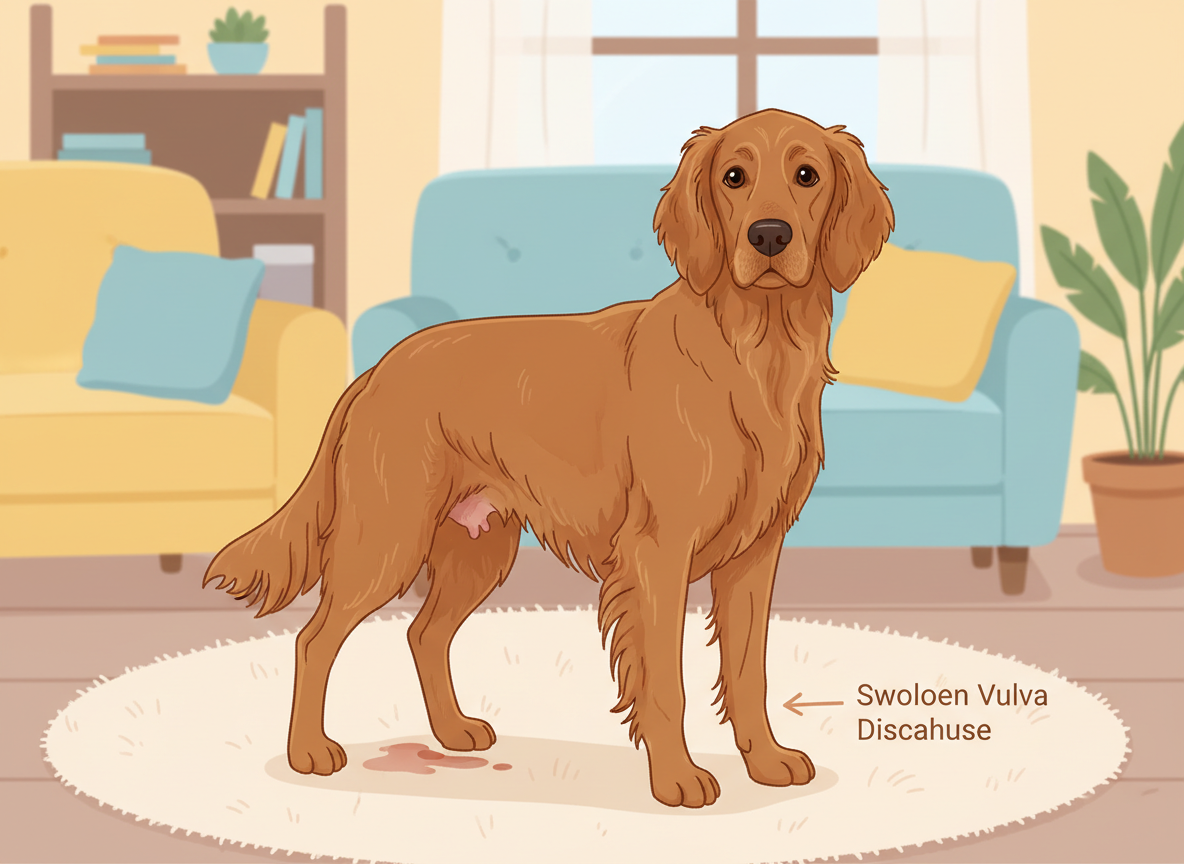
Stage 2: Estrus (about 5 to 9 days) — The Fertile Window
This is the stage that catches people out. The discharge lightens from bloody to straw-colored or pink, and many owners read that as “it’s ending.”
It isn’t. This is when she ovulates, accepts males, and can become pregnant.
What to do: Maximum supervision. Strict separation from intact males. This is not the week to relax.
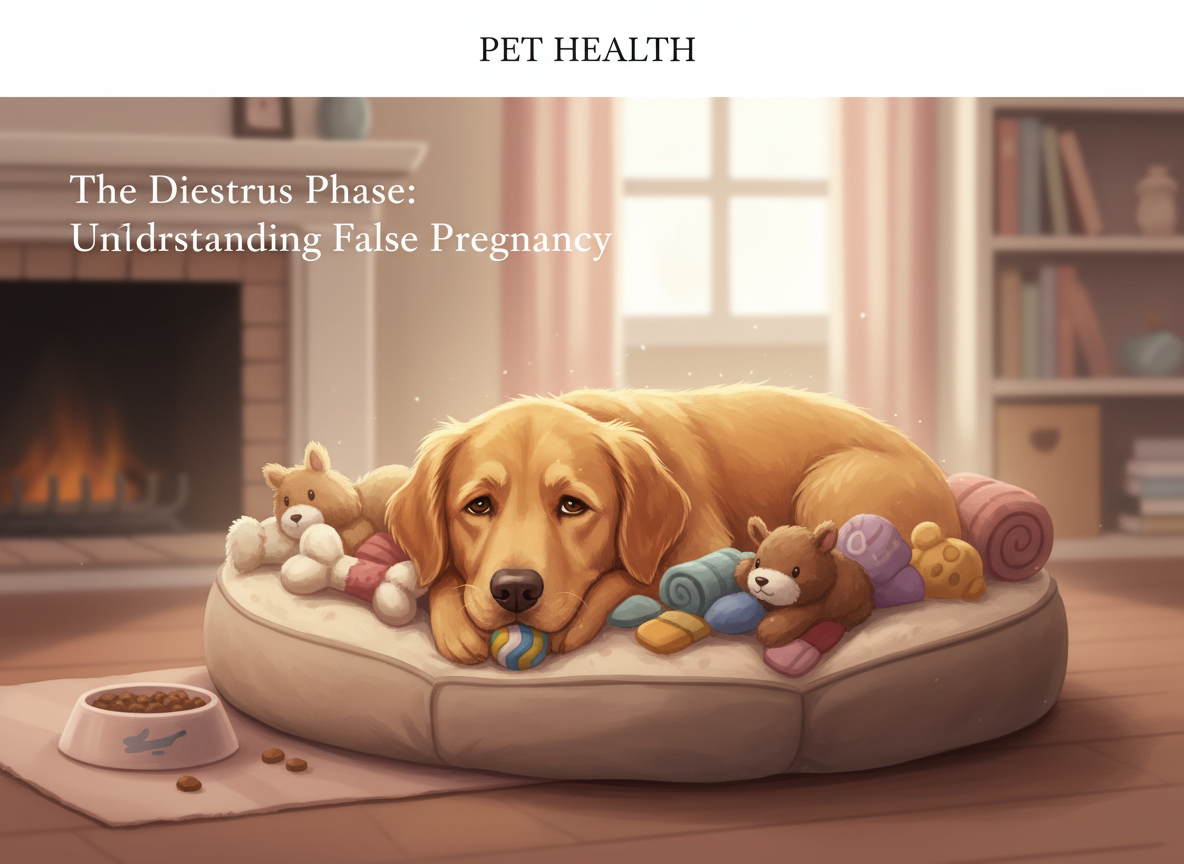
Stage 3: Diestrus (about 60 to 90 days)

The visible signs disappear. The vulva returns to normal size and discharge stops. But progesterone stays high for two to three months.
Watch for: False pregnancy symptoms, including nesting, mothering toys, and appetite changes. Also watch for pyometra warning signs, which I’ll cover next.
Stage 4: Anestrus (about 4 to 5 months)
The reproductive resting phase. Nothing is happening hormonally, which makes this the ideal window for focused training, wellness checks, and conversations with your vet about spay timing.
Which stage do you think you’ve been misreading with your own dog? Share below and I’ll help you sort it out.
The Red Flags: When to Call Your Vet Immediately
This is the part I most want you to remember.
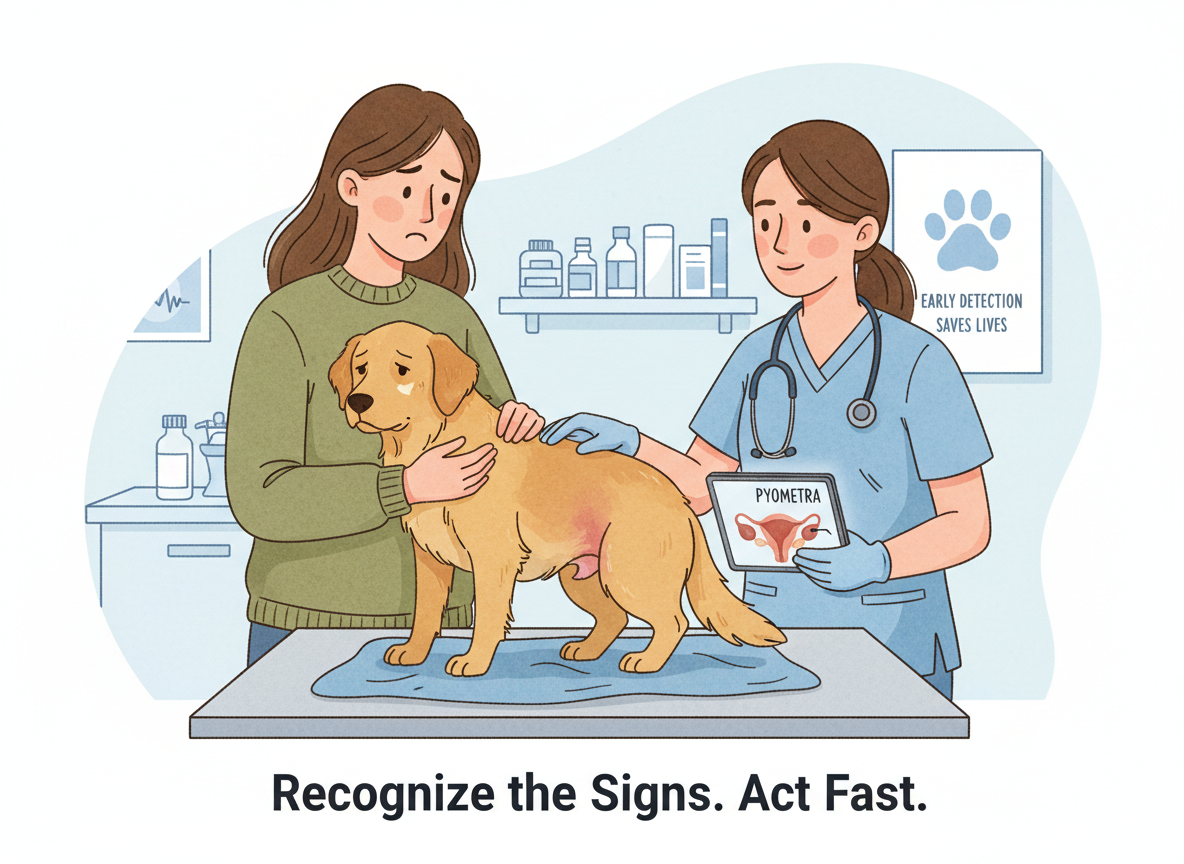
Pyometra typically develops about a month after a dog has been in heat, caused by E. coli ascending from the vagina into a uterus made vulnerable by high progesterone. Untreated, it leads to sepsis.
It is not rare. Swedish veterinary data shows incidence varies enormously by breed, from roughly 3 percent in Finnish Spitz to 66 percent in Bernese Mountain Dogs, with around 37 percent of intact Golden Retrievers affected by age 10.
Call your vet urgently if, in the weeks after a heat, you see:
- Increased thirst and urination
- Lethargy or loss of appetite
- Vomiting
- A distended or painful abdomen
- Foul-smelling discharge (or, more dangerously, no discharge with the other signs — closed-cervix pyometra is the more severe form)
Please don’t wait this one out. Even with modern treatment, mortality sits at several percent, and early intervention matters enormously.
Watch this video: The Hidden Truth About Your Dog’s Heat Cycle- What Every Owner Should Know
Real Dogs, Real Lessons: Heat Cycle Stories from My Practice
I’ve adapted these from cases I’ve seen, with names changed.
Rachel and Willow, 18-month Golden Retriever: Six weeks of “failed training” was a silent heat. Once Rachel understood the timeline, her training picked up exactly where it left off. Nothing was broken.
The Alvarez family and Nala, 2-year-old Beagle: Nala’s discharge lightened on day 10 and the family relaxed supervision. She was pregnant by day 12. They kept the puppies, but it was not the plan.
Tomás and Cleo, 7-year-old Labrador: Three weeks after a routine heat, Cleo went off her food and started drinking heavily. Tomás called immediately. Emergency surgery for pyometra. She recovered fully because he didn’t wait.
Priya and Juno, 14-month-old Shih Tzu: Juno’s first heat stopped after four days, then restarted three weeks later. Priya panicked, assuming something was wrong. It was a textbook split heat, entirely normal for a first cycle.
Ben and Maggie, 5-year-old German Shepherd: Maggie began nesting and carrying a stuffed toy everywhere two months after her heat ended. Ben thought she was pregnant. It was a false pregnancy, a normal diestrus phenomenon.
The Okonkwo family and Sadie, 3-year-old Border Collie: Sadie’s agility performance dropped sharply during proestrus. Rather than pushing, they shifted to low-key scent work for three weeks and returned to full training afterward with no lasting setback.
Has your dog’s behavior ever shifted in a way you later traced back to her cycle? I’d love to hear about it in the comments.
The Turning Point: Track the Cycle, Protect the Training
Here’s the shift I want you to make.
Stop treating the heat cycle as an inconvenience to endure. Start treating it as a predictable calendar you can plan around.
Get a notebook or a phone calendar. Log the first day you notice spotting. From there you can estimate the fertile window, anticipate the behavioral dip, and mark the date roughly 4 to 8 weeks later when pyometra risk peaks.
For training specifically, this changes everything. Hormonal disruption is temporary. Distractibility during proestrus and estrus is not a training failure, and pushing harder during that window often does more harm than good. Ease off, keep sessions short and low-pressure, and save your ambitious goals for anestrus, when her body is quiet and her focus returns.
This is where responsible dog ownership stops being reactive and becomes genuinely proactive. You can’t control her hormones. You can absolutely control your preparation.
There’s a practical benefit too. When you arrive at an exam able to say “her last heat started on the 14th of March, and she’s been drinking more since last Tuesday,” you hand your vet a timeline instead of a guess. With something like pyometra, where the interval since heat is genuinely diagnostic, that detail can meaningfully speed things up.
Key Takeaways: What Every Owner Should Know
- The heat cycle has four stages and spans 6 to 7 months, not the 2 to 3 weeks of visible bleeding.
- The fertile window arrives when discharge lightens, not when it’s heaviest, which is the opposite of what most owners assume.
- Silent heats and split heats are real, especially in small dogs and first cycles.
- Diestrus keeps progesterone high for 60 to 90 days, and pyometra risk peaks about a month after heat ends.
- Around 25 percent of unspayed females develop pyometra before age 10, with risk varying hugely by breed.
- Training regression during heat is hormonal, not a failure on your part.

Understanding the cycle protects her health and your training progress at the same time.
Take Action: Start Tracking Today
You don’t need equipment or expertise. You need a calendar and five minutes.
Today, write down the date of your dog’s last heat, or start a log for the next one. Mark the estimated fertile window. Mark the 4-to-8-week post-heat period as a watch window for pyometra signs.
Then book a conversation with your vet about spay timing if you haven’t already. It’s a genuinely individual decision involving breed, age, and health, and it deserves a real discussion rather than a default.
Come back and tell me how it goes. Share your questions in the comments, and pass this post to another owner of an unspayed female. The pyometra timeline alone is worth knowing.
This post is for general education and isn’t a substitute for veterinary care. If your dog shows signs of pyometra, difficulty giving birth, or any sudden severe symptoms, contact your veterinarian or emergency clinic immediately.
Frequently Asked Questions About the Dog Heat Cycle
#1. How long do dogs stay in heat?
The visible heat, covering proestrus and estrus, typically lasts about 2 to 3 weeks. The full reproductive cycle spans roughly 6 to 7 months.
#2. How often do dogs go into heat?
Most dogs cycle about twice a year, though the range runs from every 5 to 11 months. Some giant and primitive breeds cycle only once annually.
#3. When is my dog most likely to get pregnant?
During estrus, usually around days 9 to 14 from first spotting, when discharge lightens to a straw or pink color. Pregnancy is possible across most of the visible heat.
#4. What is a silent heat?
A cycle where typical signs like swelling and discharge are minimal or absent. It’s more common in small breeds, and the dog is still fertile.
#5. Why is my dog’s training falling apart during heat?
Hormonal changes cause restlessness, distractibility, and reduced focus. This is temporary. Shorten sessions, lower expectations, and resume normal training afterward.
#6. What is pyometra and when should I worry?
A serious uterine infection affecting about a quarter of unspayed dogs before age 10. Risk peaks roughly a month after heat ends. Watch for increased thirst, lethargy, vomiting, or abdominal swelling.
#7. Is it normal for my young dog’s first heat to stop and restart?
Yes. Split heats are common in first cycles because young dogs may not produce enough hormones to ovulate initially.
#8. When should I spay my dog?
This depends on breed, size, and health, and the evidence on optimal timing varies by breed. Have a specific conversation with your vet rather than following a general rule.
What surprised you most about the heat cycle? Let me know in the comments, and share this post with a fellow owner who’d benefit from knowing the full timeline.
Additional Readings on Dog Care:
- Essential Guide to Dog Nutrition: Feeding Tips for Happy Pets
- Unlock Your Dog’s Health: Essential Grooming Tips
- Effective Dog Weight Management Tips for Healthier Pets
- Top Vet-Recommended Dental Sticks for Optimal Dog Health
- Essential Tips for Running with Your Dog Safely
- Boost Your Dog’s Gut Health with Sauerkraut
- Is Kibble Healthy for Pets? Key Pros and Cons
- Health Benefits of Blueberries for Dogs
- 5 Grooming Tips for a Healthier Pup
- Spotting Dog Health Issues: Key Symptoms and Prevention Tips
- Essential Tips for Pet Disaster Preparedness
- Top 10 Toxic Foods for Dogs You Must Avoid
- Why Probiotics Are a Game Changer for Your Dog’s Health?
- Housebreaking 101: Master Puppy Potty Training in Just Days!
- Managing Your Dog’s Weight: Secrets to a Healthy Pup!


